Innovations Foresight On-Axis Guider (ONAG)
(Guide camera attachment device for imaging)
MSRP $989 from Innovations Foresight
http://www.innovationsforesight.com/
By Frank Colosimo
October 2011
Guiding is one of those necessary evils for high quality astro imaging. One camera company, SBIG, offers cameras with a
built-in guide chip, but some of their cameras and all others require some kind of external guiding. The two main external guiding
options up till now have been 'guide-scope guiding' and 'off-axis guider guiding'. The ONAG (on-axis guider) from Innovations
Foresight provides a new third option with unique features that combines the best qualities of both guide scopes and off-axis
guiders. I was looking for a better guiding solution and was very interested to see if this new guiding product would work out.
Background: For those of us with longer focal length scopes (over 2000 mm), guiding is a difficult proposition. In order to get
nice round stars (and not oval or 'trailed' stars) and maximum detail in our images, extreme guiding accuracy is required. Even a
good mount has some tracking error and a guide deviation of just a few pixels during a 5 minute exposure will show a distorted
shape in the brighter stars. On top of this, it can be difficult in some areas of the sky to even find a bright enough guide star to
use. So selecting the optimum guide strategy is a vital decision for astro imagers and is almost always some kind of
compromise.
Here is a review of the various guider options, based on my own education in that famous school of hard knocks:
Guide scopes: For this option, a guide camera is connected to a separate telescope that rides the mount along with the primary
scope. The main imager is attached to the primary scope and it is assumed that guide corrections supplied by the guide
scope/guide camera will accurately keep the main imager aimed at the target. The tremendous advantage to this setup is the
wide field of view that you can get with the dedicated guide camera on the guide scope. This makes it easy, in fact, almost
foolproof, to find a suitable guide star. The tremendous disadvantage is the near certainty of differential flexure, a term with
describes independent movement of the guider and main scope relative to each other. Although shorter focal length/wide field
imaging rigs seem to work OK with guide scopes, longer focal length systems do not seem to produce a good yield of high
quality images using this technique. I fought for a long time with my 2500mm scope using increasingly maniacal bondings
between the guide scope, guide camera, focuser, and imager to lock every single item into perfect rigidity, but my yield of 5
minute exposures was variable at best, and 10 minute narrowband exposures were seldom acceptable. In all fairness, some, but
not many, have claimed to have overcome all these issues and get great images using guide scopes, and my sincere
congratulations go to those who can pull this off!
Off Axis Guiders: In this option, a 90 degree-angled pick-off mirror or prism is inserted at the edge of the field near the prime
focus of your imaging scope, to relay starlight to a guide camera. Because the guide camera is attached directly to the imaging
scope you have a good chance to avoid the differential flexure issue. However, I have found that the field of view of that tiny mirror
makes it pretty difficult to find a guide star near many objects. And unless your scope has a large corrected image circle, the
quality of the star images way out there at the edge of the field may be quite poor. Finally, when I attempt to move the pick off
mirror a LITTLE farther into the beam, to get a halfway decent view of the guide stars, the darn thing starts casting a shadow or
reflections on my image. The best results from this option seem to come from those who use the highest quality off-axis guiders,
and invest in telescopes that have image circles of 50 mm or more. In addition, either manual rotation or the purchase of a
camera rotator will probably be needed in placing a suitable guide star on the guide chip.
The ONAG: Based on my testing, this new option provides the advantages of the guide scope (easy to find a guide star) with the
freedom from differential flexure of the off-axis guider. In addition, since you are not guiding on a star at the extreme edge of the
field of view, this guide strategy will work with smaller corrected image circle and let you image with an affordable scope, such as
the SCT that I started imaging with.
So exactly what is the ONAG, and how does it work?
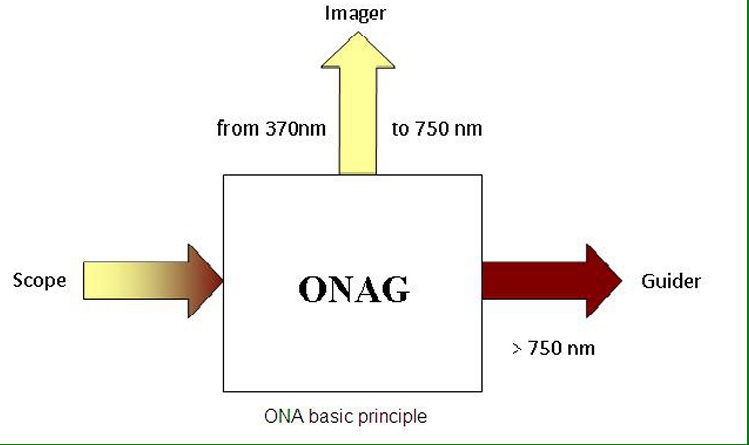
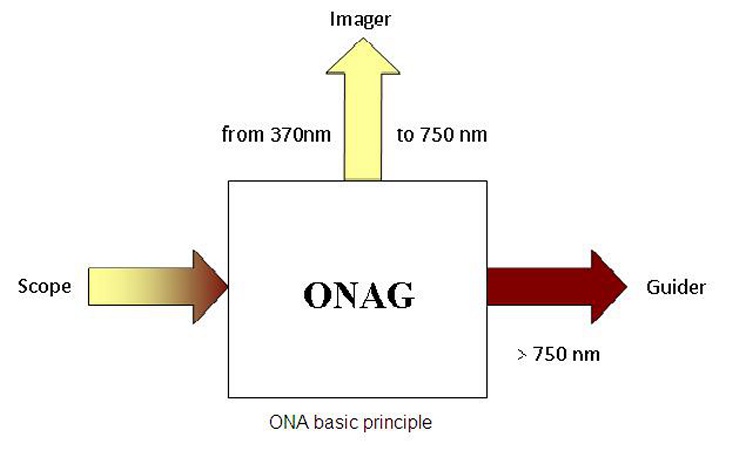
Here is a diagram that shows the various parts of the ONAG
The ONAG is attached to your scope as shown above (toward the left). Your imaging camera is attached to the side port (top
in the diagram above) and your guide camera is attached at the back (the right). A high-quality, optically flat multicoated
dichroic beam splitter, or "cold mirror" is installed at a 45 degree angle inside the body of the ONAG. It reflects the visible
light, from 370nm to 750nm, toward the imaging camera. The remaining near-IR portion of the light passes through the
mirror and travels toward your guide camera.
It should be apparent that the guider has a great view of the star field presented to your scope, and the large amount of
Infrared energy in starlight (and the great sensitivity of CCD cameras to IR) means that you get a great selection of stars to
use for guiding.
What is in the package?
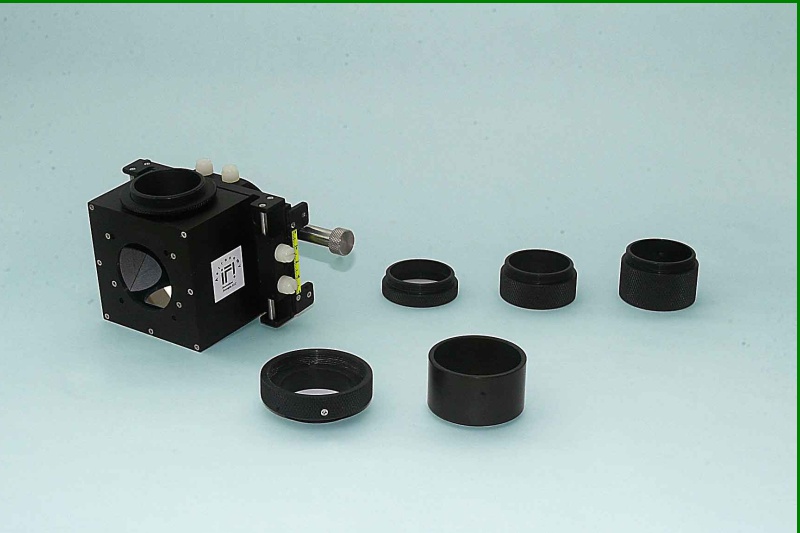
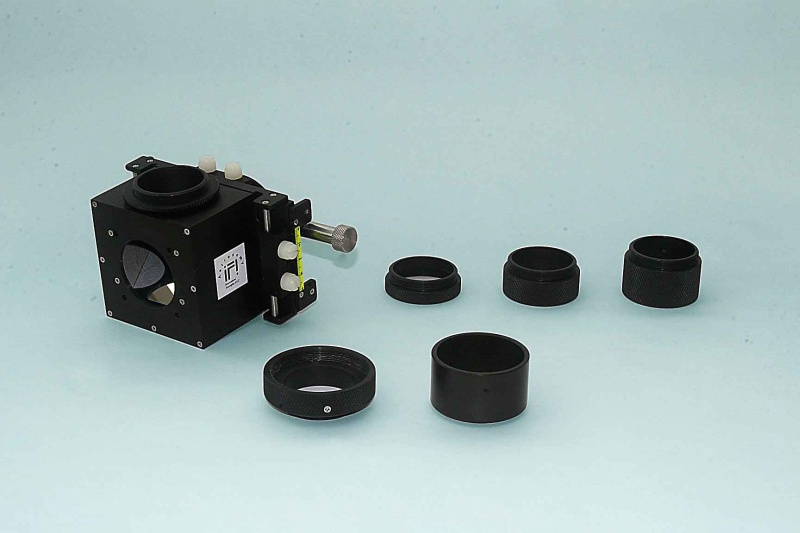
The ONAG comes with T-Thread adapters and some extension rings as show here:
The scope port allows the ONAG to be attached to any scope using a standard T-threaded female connection (M42 x 0.75). The ONAG
comes standard with a 2" tube adapter, and a low profile SCT female adapter. I found that this connection was nice and rigid to prevent
drooping of the fairly heavy imaging equipment that I was using.
The imager port is used to attach the imaging camera and related accessories, such as a filter wheel, to the ONAG using a standard
male T-thread. A low profile T-threaded ring is provided to secure the camera at the desired position.
A guider port is used to attach the guider camera to the ONAG using a male T-thread. A low profile T-threaded ring is provided to secure
the camera at the desired position. The guider port contains a guider focuser drawtube, which provides up to 9 mm of travel to adjust the
guider focus. The focuser uses a heavy duty compressing ring to insure a 360 degree grip on the drawtube. The drawtube is 1¼" in
diameter and can be removed, so this allows the use of any standard 1¼" accessories.
An X/Y stage allows easy and quick search for a suitable guide star. It is attached to the ONAG body on one end, while it supports the
guider focuser on the other end. The stage slides in both directions (X, Y axis) using two stainless steel shafts; each axis can be secured
with four nylon screws to lock it into position.
Three T-threaded extension tubes are also supplied. These are 8 mm, 16 mm and 24 mm long. They can be used in any of the ONAG
ports With the proper combination they allow a wide range of cameras (including DSLR) and guider to reach focus simultaneously.
Build quality: The build quality is excellent. The body is made up of aluminum and stainless steel and surfaces in the optical path are
anodized with optical grade black, which provides prevents IR reflections that show up with less grades of anodizing.
Setting up the ONAG:
As with all imaging devices, some planning has to go into how the parts will connect together. I used the ONAG on my Starizona Hyperion
telescope with a Apogee Alta U8300 camera. The filter wheel was a 7 position model from Finger Lakes imaging, with 50 mm filters. For
guiding, I used my trusty SBIG ST402 camera. Since my scope's focuser was configured with AP 2.7 inch threads, I used the Innovations
Foresight AP adapter on the scope port. The imager port was configured with the SCT thread (two inch, 24 tpi) adapter to connect to the
FLI filter wheel. The filter wheel was directly attached to the Apogee camera. The guide port connection to the ST-402 camera was easy
since like many guide cameras, it uses the T-thread for connections. After a little trial and error, I found that the 16mm extension brought
the guide camera to the same focus as the imaging camera. The Hyperion has an excellent Feathertouch focuser, but the big focuser
body uses up a lot of the back focus available to the scope. With the ONAG, I found that the focuser was racked in pretty far, but I had
enough travel to use FocusMax for automated focusing with no problems.
Since I mostly use fully-automated imaging with CCD Autopilot software, I fixed the XY stage to be somewhat off axis and left it there
during all imaging. There were many guide stars available in any given field of view, so I just let the software locate a star to use for
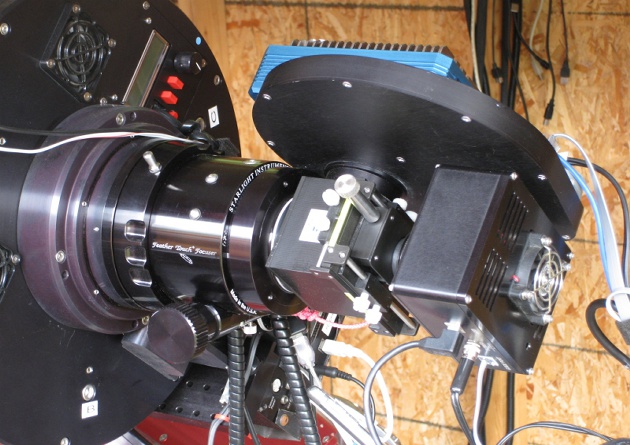
guiding. Here is an image of my system with the ONAG in place:
Performance:
I ran several tests to look for any unusual effects from the ONAG as well as to evaluate its main purpose as a guider.
Image effects: Can you really bounce the image 45 degrees off a 'cold mirror' without noticeable optical degradation? That was my
question, so I ran several tests with and without the ONAG in the imaging train. In these tests, I could find no aberrations in the images with
the ONAG, even when I blew up the images to 400% in Maxim/DL. I also use a program called CCD Inspector to evaluate images, and the
ones that I gathered with the ONAG provided the same FWHM readings that I was used to seeing. I saw no signs of vignetting with my
imaging system using the U8300 camera (22.5 mm diagonal chip). What I did see was that the images were reversed since they were
being bounced off a mirror. This is easily fixed with imaging software, however.
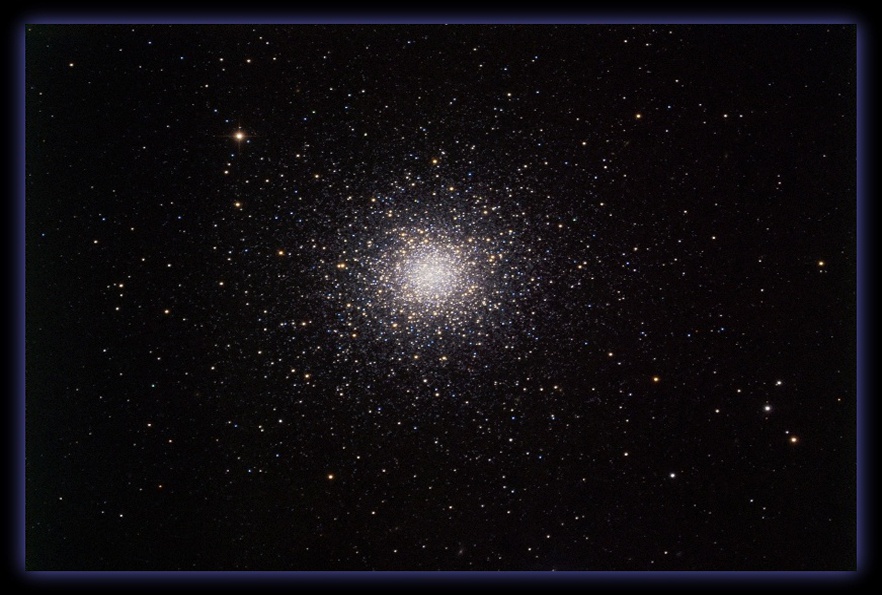
Guiding: I ran a guiding test on M13 where I took successive 1 minute exposures for over an hour, resulting in 60 plus images, while
continuously guiding the whole time. The guide graph looked great but a careful examination of the images would tell me whether I was
getting any differential flexure between the perfect guiding and the actual imaging camera. I made a movie of the frames so I could watch
for movement. What I saw was very gratifying - the image stayed in the same place and although there were small random displacements
due to seeing effects, there was no directional drift as I have seen from differential flexure in the past. Images from the first and last part of
the exposure series were superimposed and showed that the stars were in the same place. I don't plan to run hour-long subexposures but
it is nice to know that I can go as long as I want without any differential flexure drift.
Imaging tests: I gathered images as I normally would, using Maxim/DL, FocusMax, and CCD Autopilot. I found that the correct guide
setting for CCD Autopilot was the 'self-guided' setting, which is the same one that is used for cameras with internal guide chips. Since I use
TheSky v6 for running the mount and interfacing with CCD Autopilot, I planned to map out a custom Field of View reticle to help plan
image rotation to select the best guide stars for images. However, in practice I found that no rotation was necessary to get a good guide
star in almost all objects that I selected, so I never quite got around to completing this task.
Results:
Here are several images that I collected, stacked, and processed using Maxim and Photoshop:
Messier 3 (M3, NGC 5272), the magnitude 6.2 globular cluster in Canes Venatici
Location: Blue Mountain Vista Observatories, New Ringgold PA
Optics: Hyperion f/8 12.5 inch, FL 2540 mm
Mount: Paramount ME
Camera: Apogee U8300
Guiding: ST-402 on Innovations Foresight On-Axis Guider
Exposure: RGB (unbinned): R:15x7 min, G:11x5 min, B:9x8 min
Processing: Image acquisition using CCD Autopilot. Initial processing
was done using Maxim DL with subsequent processing with Photoshop.
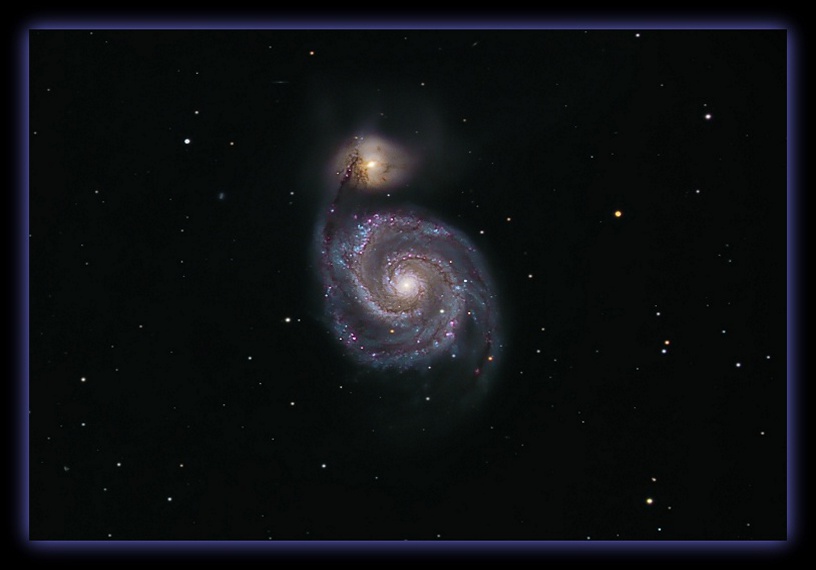
M51 or NGC 5194, the magnitude 8.4 spiral galaxy in Canes Venatici
Location: Blue Mountain Vista Observatories, New Ringgold PA
Optics: Hyperion f/8 12.5 inch, FL 2540 mm
Mount: Paramount ME
Camera: Apogee U8300
Guiding: ST-402 on Innovations Foresight On-Axis Guider
Exposure: LRGB: L:24x10min R:10x8 min, G:8x6 min, B:11x6 min
Processing: Image acquisition using CCD Autopilot. Initial processing was done using Maxim DL
with subsequent processing with Photoshop.
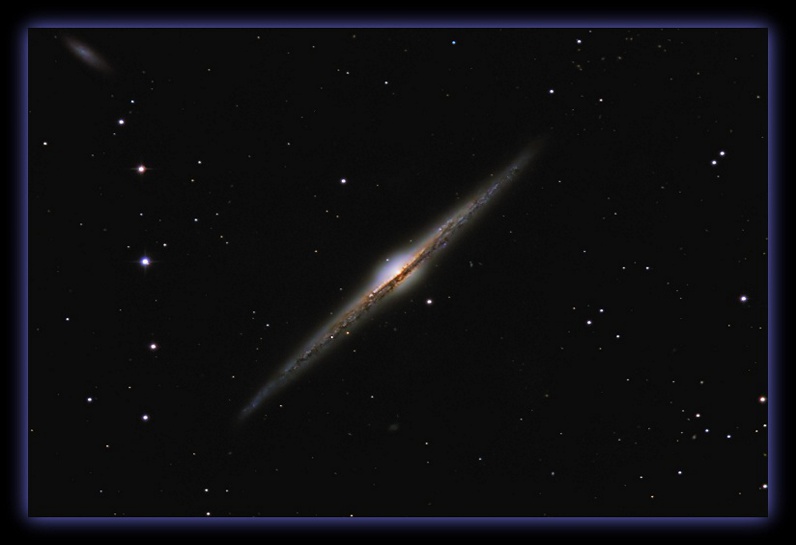
NGC 4565, the magnitude 10.4 edge-on spiral galaxy in Coma Berenices .
Location: Blue Mountain Vista Observatories, New Ringgold PA
Optics: Hyperion f/8 12.5 inch, FL 2540 mm
Mount: Paramount ME
Camera: Apogee U8300
Guiding: ST-402 on Innovations Foresight On-Axis Guider
Exposure: LRGB: L:23x10min R:17x7 min, G:14x5 min, B:18x8 min
Processing: Image acquisition using CCD Autopilot. Initial processing was
done using Maxim DL with subsequent processing with Photoshop.
Conclusions:
In my tests, the ONAG appears to live up to its claim to be an effective new option for guiding, even with longer focal length
scopes. I found that it provides the same ease of guide star selection as a guide scope without the differential flexure problems
that I have seen with my own guide scope tests. It provides a larger star field for guiding than Off-Axis guiders. I plan to continue
to use it with my Apogee camera as the only method of guiding.